The Volta: Difference between revisions
mNo edit summary |
mNo edit summary |
||
| Line 14: | Line 14: | ||
[[File:tmp650428011748786177.jpg|400px|]] [[File:Tmp666938829617233922.jpg|400px|]] | [[File:tmp650428011748786177.jpg|400px|]] [[File:Tmp666938829617233922.jpg|400px|]] | ||
''Illustration 2, left'': The Volta at Queen Elizabeth I's Coronation Banquet 1559. http://www.historyextra.com/sites/default/files/Elizabeth%20I%20dancing%203.jpg. | ''Illustration 2, left'': The Volta at Queen Elizabeth I's Coronation Banquet 1559. http://www.historyextra.com/sites/default/files/Elizabeth%20I%20dancing%203.jpg. [add full bibliographical information to ''Sources''] | ||
''Illustration 3, right'': The Volta. http://www.thebluegrassspecial.com/archive/2011/august2011/imagesaugust2011/capriol.jpg. | ''Illustration 3, right'': The Volta. http://www.thebluegrassspecial.com/archive/2011/august2011/imagesaugust2011/capriol.jpg. [add full bibliographical information to ''Sources''] | ||
Revision as of 17:08, 7 January 2018
Italian for "turning", also spelled Lavolta, Levalto, in France referred to as a Galliard.
The Volta is a French dance that was very popular in the 16th century as part of the Renaissance Court Dances. It is still known as the favorite dance of Queen Elizabeth I [source?]. Being an intimate dance between couples, the Volta was widely rejected: "In spite of royal participation, this dance was considered vulgar by the élite, and the young Capriole in Arbeau's Orchesography suggests that it is not either 'beautiful or descent unless you are dancing with some buxom serving wench'" (de Banke 232). It only became somewhat respectable after Queen Elizabeth danced it with the Earl of Leicester at her Coronation Banquet in 1559.
It is performed with an intimate embrace of the dancing partners, each holding the other tightly, and is composed of a series of complex hops, steps, leaps, and turns. Its signature move is the man lifting the woman into the air, which is called the caper, spinning her around and setting her back on the ground. The caper needed timing and strength and reflected intimacy between the couple. The man's one hand lies on the ladies' back, the other on the crotch near the bottom of her busk (made of wood or metal). At the same time, the gentleman's one knee is under her buttocks to push her further in the air. Meanwhile, the woman's right-hand pushes down on the man's shoulder, the other holding down her skirt. Many moralists of that time considered the Volta obscene because of the glimpses on the female leg when pushed in the air, as Suzanne Lord explains: "Skirts flew, ladies' knees were exposed, and people sweated. Ladies who intended to dance a Lavolta decorated their garters with gold and silver ornaments because those garters would be seen during the dance" (145). While pushing the lady into the air, the gentleman turns her into another direction. The step sequence was as follows:

Illustration 1: Step sequence of the Volta after Cécile de Banke in Shakespearean Stage Production: Then and Now, p. 232.
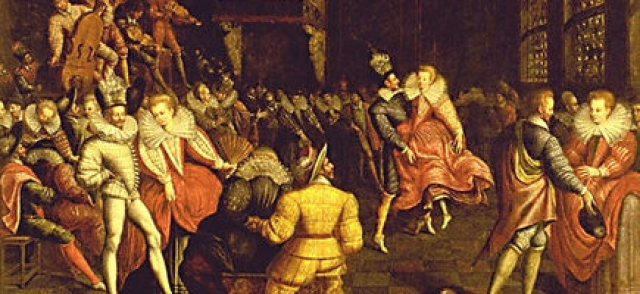
Traditionally, one of the partners starts with his steps and kicks to open the dance until the other joins in. In Elizabeth (1998) one can watch Queen Elizabeth I and Robert Dudley, Earl of Leicester, dance the Volta at her Coronation Banquet (Link: https://www.youtube.com/watch?v=nx002D9N6qU). Also the paintings below (Illustrations 2 and 3) show the two dancing. After Elizabeth's death the Volta nearly disappeared and only survived as a folk dance in Provence, France.


Illustration 2, left: The Volta at Queen Elizabeth I's Coronation Banquet 1559. http://www.historyextra.com/sites/default/files/Elizabeth%20I%20dancing%203.jpg. [add full bibliographical information to Sources]

Illustration 3, right: The Volta. http://www.thebluegrassspecial.com/archive/2011/august2011/imagesaugust2011/capriol.jpg. [add full bibliographical information to Sources]
Sources
de Banke, Cécile. Shakespearean Stage Production: Then and Now. Routledge, 2014, Google Books, https://books.google.de/books?id=nThHBAAAQBAJ&pg=PA232&dq=lavolta+dance&hl=de&sa=X&ved=0ahUKEwibiL2dl77YAhXM-6QKHWyvB0YQ6AEIODAC#v=onepage&q=lavolta%20dance&f=false. Accessed 28 December 2017.
Knowles, Mark. The Wicked Waltz and Other Scandalous Dances: Outrage at Couple Dancing in the 19th and Early 20th Centuries. Kindle ed., McFarland & Co. Inc., 2009.
Lord, Suzanne. Music from the Age of Shakespeare: A Cultural History. Kindle ed., Greenwood, 2003.
Nevile, Jennifer. Dance, Spectacle, and the Body Politick, 1250-1750. Indiana UP, 2008.